Newsletter
Construction updates, fascinating glimpses into our workshops, and highlights from our shop. Discover all this and more in our newsletter.
Simple yet complex—a brief introduction to an art movement of over 100 years
Simple yet complex, perhaps this is how one could sum up Concrete Art. What is clear and unambiguous is that this art movement does not attempt to depict reality. Instead, it elevates artistic media—namely color, form, line, and material—to convey its visual, purely intellectual messages. Therefore, it is concretely what it is: namely, the interplay of these non-representational components. At the same time, it can be experienced via the senses without prior knowledge. Furthermore, a geometric formal language plays an essential role, although the style cannot be reduced to it. The principles of Concrete Art are applied not only in painting, graphic art, or sculpture. Those principles are also firmly established today in all other visual genres—in the applied arts, design, architecture, even literature.
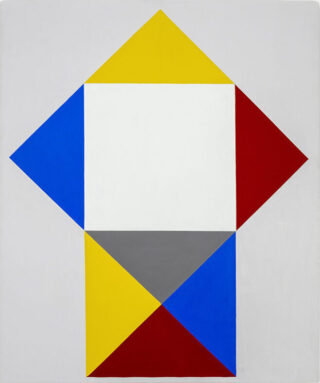
Anton Stankowski (1906–1998), Aufgeklappt auf Weiß (Unfolded on white), 1989, acrylic on canvas, 90 x 65 cm, © Stankowski-Stiftung, Stuttgart; Photo: Museum für Konkrete Kunst und Design, Helmut Bauer
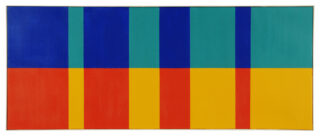
Max Bill (1908–1994), Vierfarbige Struktur (four-color-structure), 1970, oil on canvas, 60 × 150 cm, © VG Bild-Kunst, Bonn 2026; Foto: Museum für Konkrete Kunst und Design
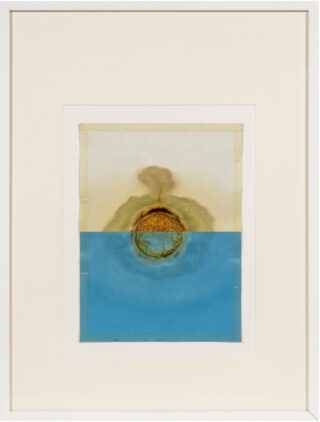
Dieter Roth (1930–1998), Kleiner Sonnenuntergang (Small sunset), 1968, salami slice, colored cardstock, plastic bag, 82,5 × 63 cm; Foto: Museum für Konkrete Kunst und Design
The roots of this art movement lie in the first decades of the 20th century, when the avant-garde of the time radically broke with the previously prevalent pictorial traditions. Kazimir Malevich’s Black Square, created in 1915, is considered the “Big Bang”—a painting that “shows” nothing but a black square on a white background. Alongside Malevich and other representatives of Russian Constructivism, the Dutch group De Stijl led by Piet Mondrian and Theo van Doesburg (the movement’s namesake) as well as the German Bauhaus were important early catalysts for Concrete Art.
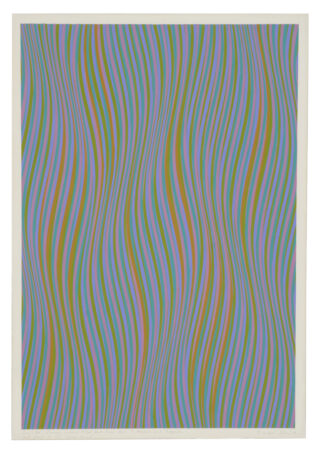
Bridget Riley (*1931), Series 38, Orange added violet and green and 15 Magenta and Turgenoice, both pairs in two colour twists, 1979, Oil and gouache on cardboard, 95 × 67 cm, © The Bridget Riley Art Foundation; Photo: Museum für Konkrete Kunst und Design
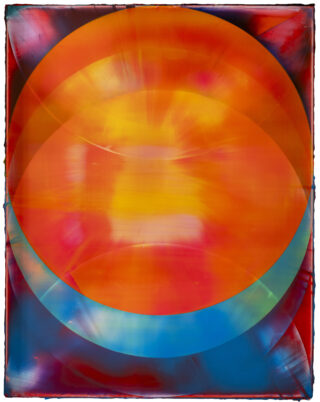
Shannon Finley (*1974), Sunset, 2015, acrylic on canvas, 140 × 100 cm; Photo: Museum für Konkrete Kunst und Design, Hubert P. Klotzeck
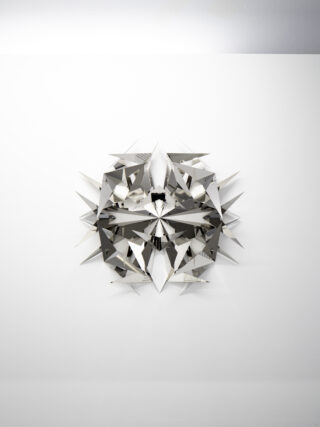
Timo Nasseri (*1972), Glance #9, 2022, stainless steel, 88 × 84 × 20 cm, © VG Bild-Kunst, Bonn 2026; Photo: Museum für Konkrete Kunst und Design, Hubert P. Klotzeck
Further development of the style and its distinction from other movements with comparable principles is more complex. While the Zurich Concrete artists around Max Bill advocated a mathematical, unambiguously scientific interpretation of Concrete Art from the late 1930s onward, similarly oriented but significantly more open movements emerged in the postwar period with Op Art, Minimal Art, and Concept Art, as well as the group ZERO. Against this backdrop, the term “Concrete Art” lost its significance latest by the 1970s, though many of its principles remain relevant to this day.
The broad spectrum that Concrete Art can currently represent is hinted at by some personal perspectives of young contemporary practitioners. Their statements often align with the principles formulated by the movement’s pioneers, such as van Doesburg or Bill, in the first half of the 20th century. Thus, Concrete Art encompasses rigor just as much as play and chance—sometimes even all at once.