Newsletter
Construction updates, fascinating glimpses into our workshops, and highlights from our shop. Discover all this and more in our newsletter.

In 1992, a unique institution opened its doors in Ingolstadt: the MKK—Museum of Concrete Art. It was and remains to today the first and only institution in Germany dedicated exclusively to Concrete Art. The starting point was the collection of the writer and founder of Concrete Poetry, Eugen Gomringer (1925–2025).
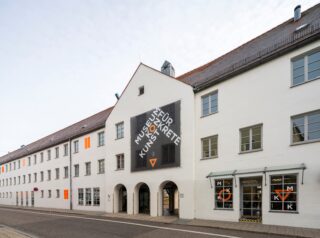
Outdoor shot Tränktorstraße © Hubert Klotzeck
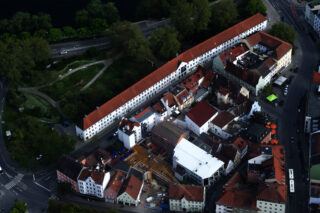
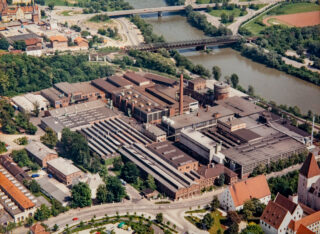
Aerial photograph © Horst Schalles
The “Quartier G - Alte Gießerei”, where the future MKKD is located, has a long and eventful history.
As early as the 13th century, a suburban settlement stood on the site and, from the 16th century, a fortification to protect the city from invaders. In the 19th century, the “Königlich Bayerische Geschützgießerei und Geschoßfabrik” was founded here and Ingolstadt became a military town. Before the First World War, 17,000 workers worked on the site of the armaments factory.
After the war, the site was used for a variety of purposes. Auto Union was based there for a time. Fittings and spinning machines were also manufactured on the site.
During the Second World War, the factory also served as an armaments factory and produced components for military equipment. Post-war, the “Deutsche Spinnereimaschinen AG Ingolstadt” and later also the “Schubert & Salzer Maschinenfabrik AG Ingolstadt” occupied the buildings. Some of the buildings have been listed since 1996.
And the transformation continues: With the Technical University and its institutes, the brigk, the MKKD, the Audi Academy, the Maritim Hotel with the Congress Centrum and the Ingolstadt Business and Science Promotion Agency, a unique center for science, research and art is currently being created on the site.
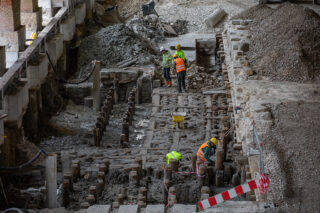
The conversion of the Gießereihalle (foundry hall) into the Museum für Konkrete Kunst und Design (MKKD) brought to light numerous archaeological finds, which were documented and secured by the specialist company Pro Arch Prospektion und Archäologie GmbH. Since 2012, an excavation team of up to 15 people has worked on a total of eight plana*. The team documented over 1,705 findings, which were unearthed, measured, photographed, and interpreted.
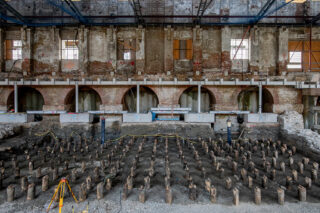
The archaeological monitoring of the conversion of the so-called Gießereihalle, which included a deep underground space beneath the building, provided valuable insights: Remains of the original workshop equipment (machine foundations) as well as finds dating back to Ingolstadt’s Renaissance and a Baroque fortress were discovered.
The high groundwater level of the site posed major challenges for both earlier builders and modern architects. Similar to the foundations of Venice, the fortress walls and the gun foundry have been built on numerous wooden piles, some of which were reinforced with iron bands. This foundation was removed for the construction of the new MKKD.
The unique site is meticulously documented in order to make the findings accessible for future research.
* In archaeology, the so-called planar excavation refers to an excavation for artificial layers (arbitrarily chosen at random by the excavators). Plana or trenches sections of regular thickness are removed, and the features findings are measured on these flat surfaces.
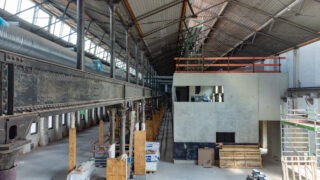
Construction work in June 2021 © Pro Arch, Johannes Hauser
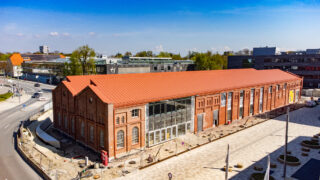
The museum is currently undergoing an impressive transformation: its new exhibition venue at “Quartier G” is scheduled to open in 2027. A historic 19th-century gun-boring and artillery workshop, widely known as the Gießereihalle (foundry hall) despite the name being somewhat inaccurate, is being transformed into an inspiring space for art and design.
Alongside temporary exhibitions, the new venue will showcase the MKKD's collections, works from the Foundation for Concrete Art and Design (SKKD), and other displays. Visitors will be able to explore the history of Concrete Art, while a varied program will also carry this artistic movement into the future.
Snapshots of the building site over the past few years © Johannes Hauser