Newsletter
Construction updates, fascinating glimpses into our workshops, and highlights from our shop. Discover all this and more in our newsletter.
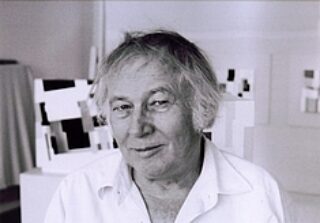
Before devoting himself to painting, Otto Nemitz pursued various occupations. Beginning in 1962, he turned to constructive-concrete art.
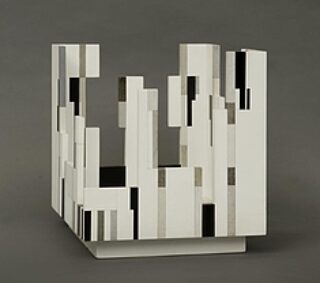
Initially, he executed his paintings with a restrained palette of black, white, and gray, which formed a kind of geometric grid. By the late 1960s, his non-representational compositions—now more intensely colored and featuring partly organic forms—became increasingly dynamic and fluid. With the Time Houses starting in 1995, Otto Nemitz found a form of expression that marked a consistent evolution of his work. The now three-dimensional sculptures, standing freely on pedestals in space, seemed to be the spatial realization of his drawings, paintings, echoes, and shadow images, transformed into objects. The boundary between the genres of painting and sculpture was dissolved.
Otto Nemitz (1935–2012), ZH13, 2000, 35 × 35 × 35 cm, acrylic, graphite on wood; Photo: Museum für Konkrete Kunst und Design, Helmut Bauer
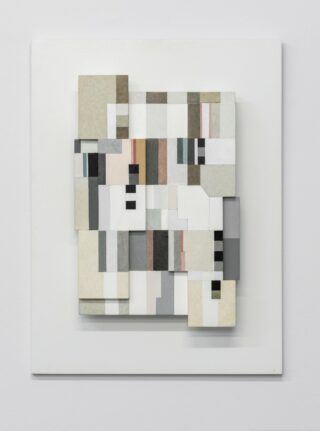
Otto Nemitz (1935–2012), EB 40, 2008, acrylic on wood, 56.5 × 37 × 7 cm; Photo: Museum für Konkrete Kunst und Design, Helmut Bauer
Born in Berlin
Self-taught in the graphic arts, evening courses in drawing and painting techniques
Study visit to Italy, landscape painting
Moved to Cologne
Founded the “Kleine Galerie Köln” forum for emerging artists
Rhine-Tiber Prize from the City of Rome
Studied art history and philosophy at the University of Cologne
Study trip to Australia
Symposium “The Spiritual in Contemporary Art, Illustrated by the Example of Otto Nemitz” at the Thomas Morus Academy, Bensberg
Died in Cologne
Inducted into the SKKD
Becoming MKKD. On Planning and Creating a Museum (group exhibition)
Painting, Boundless
Black on White: Highlights from the Maximilian and Agathe Weishaupt Collection and the Foundation for Concrete Art and Design (group exhibition)